Saturday, July 30, 2011

July 30, 2011

I’ve always told people who’ve asked me about the greens staff that I work with best people that I have ever worked with...every day they teach me something new and inspire me.

The following is an email I received today that goes with everything I have ever said of the greens department staff –

Ken,
  I just had a call from Melissa Fata - the head teller at Cape Bank in Linwood.  They have been doing a food drive for the last couple of weeks.  Today Clara, Denia, Pedro, Edgar, Marisol, Max, Isabella and Isidro came in to cash their checks and brought quite a bit of food to donate.  Melissa said the box is now overflowing.  She was so touched by their generosity that she just had to call and tell me.  She also said they are always so pleasant when they come in.  Please let them know their “good heartedness” does not go unnoticed!  We are lucky to have them as part of our team.
Have a Greate day!
Candy Jankowski

Saturday, July 23, 2011

July 23, 2011


On Friday, July 22, the temperature rose to 102 degrees with a heat index topping out at 116 degrees. Although we had many hot days last year, this day beat them all. Today is forecast to be pretty much the same.

We continue to do all we can to hold conditions. Cool season turfs such as bentgrass, blues, and ryes will decline in this heat. Poa annua, a winter annual, simply wants to“check out” as it has evolved to do and is supposed to do.

To relieve the heat we increase syringing – not watering. Syringing is the art of applying a small amount of water on the plant to cool it down. Just like us and any other life of cells, turf can suffer fatal heat exhaustion. Consistently cooling it down throughout the day can help to prevent turf from becoming over heated, increasing poa’s chance of survival, and suspending decline of the other grasses.

At the same time, as heat weakens turf and its natural defenses, diseases have an easier time of taking over. Brown patch, pythium, and anthracnose are the most active in the heat, and if left unchecked, these diseases can take out acres of turf in hours-yes! in hours!

We have applied preventative fungicide sprays to the greens, tees, and fairways to suppress these diseases. They can never be eradicated totally, so we have to be diligent and watch for any “breakthrough” so that we can reapply fungicides immediately.

The heat is not a good thing – it is really tough on the grasses, and on people. We will just continue to do the things we do and do them to our best ability so that the turf has its best chance of making it through these ridiculously hot periods.
Using ice to cool turf on 7 tee. Also, as the ice melts, the cold water seeps into the soil and drops the soil temperatures
Poa yellowed due to heat stress, but will recover when the temps go back down.  

Edgar cooling down the 7th green
Close up of a syringe/ misting nozzle.
Pythium on ryegrass rough

Sunday, July 3, 2011

July 3, 2011

The Southern Pine Beetle (SPB) population has been on the increase in southern New Jersey, and we recently have identified it on the golf course, most notably in the areas near the 13th green and 4th tee.

The SPB attacks all pines, but favors the native pitch pine. The adult beetles bore into the inner bark and the female then lays her eggs. The hatched larvae then feed on the inner bark, girdling the tree on the inside.  The beetles also transmit “blue stain fungi” which colonizes in the trees xylem, blocking water movement in the tree. When these larvae mature, they bore out of the tree and fly to a host tree to lay their eggs and the process begins again with a new generation. Once infested with the beetle and blue stain fungi, the tree is certain to die with in a month or two.

Spraying a pitch pine near the 11th green.

Having found the SPB, we have contracted with a local tree service to do preventative sprays to do our best to hold off further infestations. Last Thursday we sprayed about 50 trees and next week we will spray at least as many more. Due to the expense, we will be concentrating on the specimen pine trees and ones that are “part of the course”. Our plan is to protect as many of these pines as is feasible.

Dead pitch pines to the right of the 13th green that were attacked by the SPB and blue stain fungi earlier in the year.


Tuesday, June 21, 2011

June 21, 2011

The summer solstice occurs at 1:16 pm today! and is the day of the year in the northern hemisphere with the most time of daylight! Sunrise today occurs at 5:32am and sunset at 8:28pm – 14 hours and 56 minutes of daylight today! From this day on til the winter solstice in December, the days will become shorter...

The summer solstice is considered to be the first day of summer, although there is no official decree or law to make it so. It’s just an “easy out” on the calendar! Throughout the world, people celebrate the solstice with parties, pagan ceremonies, prayer, music, etc, and of course, somewhere, probably at a Wal Mart, there is a solstice day sale.

No matter how, or even if, you celebrate the solstice, have a great day and a great summer!

Monday, June 20, 2011

June 20

What makes greens speed? Is it just shaving the down the greens? Is it really that simple?

Greens speed isn’t that simple. Height of cut does play a role, but shaving down the greens is not the only factor. Green speed also depends on many other factors and the consistency of maintenance programs – some of these are mowing frequency, rolling, topdressing, soil moisture management, verti-cutting, growth regulators, and fertility. Green speed is also a function of weather and turfgrass variety. Because of all the necessary programs, green speed also depends on a lot of person power. Green speed is something that must be planned for, not just “made”. And not just accomplished by green height.

When we plan for a tournament, preparations to produce a target green speed begin at least six or more weeks in advance. All the programs are increased to peak the greens at the time of the tournament. If we have timed every thing correctly, the greens will top out at tournament time, and be healthy enough to recover from the stress incurred. The longer we maintain them in this manner, the weaker they become due to all the stresses put on the plants, which is why the greens cannot be kept at tournament speeds at all times. Even US Open and Master’s greens don’t stay fast for very long...

Thursday, June 9, 2011

June 9, 2011


Everything these days are computers, ipads, clouds, blackberries, and all the other stuff that can do it all...but I am a bit like Wendell Barry, who in his essay, “Why I Am Not Going to Buy a Computer”, explains why he still uses a pencil when he writes...

I am that way about some things...

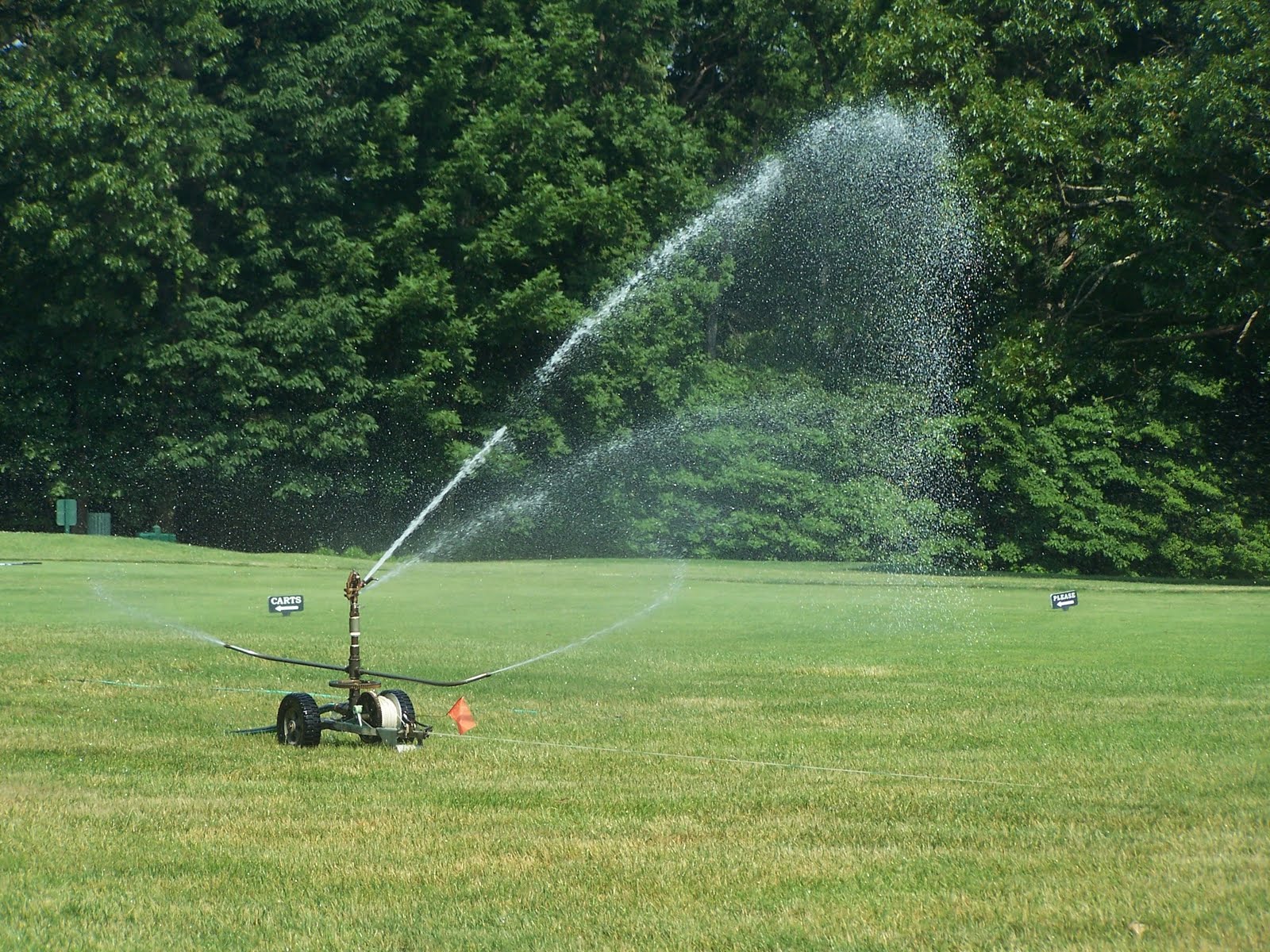
I still use a knife to cut open the turf to look for bugs and make counts, check the greens with an old fashioned soil probe to look at the roots and the soil moisture. I dont use a lot of the digital stuff that claims to do this for me....I still like to rely on my own senses and instincts that I have honed and have learned to trust over the past 50 plus years...and I still like to use the old traveling sprinkler.

I have been using these things since I started out in the business. Some are driven by a diaphragm, and others are gear driven; both use the water pressure as energy. Ours are gear driven. Not much can go wrong!

Traveling sprinklers are a great to supplement large areas that do not get enough coverage from the “computerized” automatic irrigation system. Many days we use ours on the rough areas on 4, 7 and 8. All we need to do is set it up, and then move it when it gets to the end of its run. The traveling sprinkler is very dependable and efficient, and while it is doing the watering, we can be off somewhere else doing other things!

I guess I could add a digital readout, a key board and some blinking lights to the frame to make it look high tech, but I know it wouldn’t work any better. It’d probably get a virus and crash...so I will leave it the way it is....plain and dependable!

Saturday, May 28, 2011

May 28, 2011


I am hoping that you have noticed a few “changes” that we’ve recently made to the golf course!

On the fourth green we completely renovated the green surrounds. We re-graded and drained the entire area, redesigned both left side bunkers – even making a sod wall bunker back left - updated the irrigation, removed trees, and planted a privet hedge to screen out the road that runs right of the green.

On the fifth tee we removed five trees that interfered with tee shots and removed a section of the cartpath. We removed one chestnut tree at the left of the fairway too.

Behind the fifteenth green we planted 65 Leyland Cypress trees to screen out the traffic on Route 9. We planted more privet behind the seventeenth tee and fourth tee, also to screen out traffic on Route 9.

On the sixth hole, we repaired the right side bunker and sodded the high traffic area near the green.

I think that these changes will make the course more playable and enjoyable for everyone.